

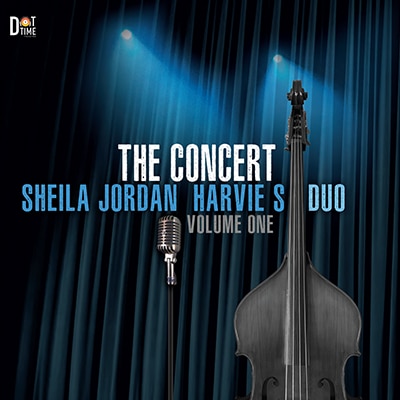
THE CONCERT
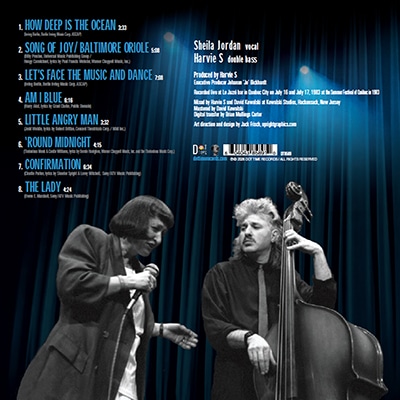
This album, recorded at the 14th Summer Festival of Québec in 1983 but unissued until now, captures the otherworldly rapport of a singer and a bassist whose partnership knows no equal in jazz history.
Sheila Jordan, then 54, was a Charlie Parker protégé whose work defined idiosyncratic. She sang in a cool, breathy, vinegar tone with a shivering vibrato. To her bebop vocabulary she added bursts of Native American melisma, a nod to the Cherokee roots in her family tree. Harvie Swartz (now known as Harvie S), 20 years her junior, was turning the upright bass into a solo instrument with an almost unrivaled range of textures, colors,and rhythms.
HARVIE S & SHEILA JORDAN THE CONCERT 11/20/2026
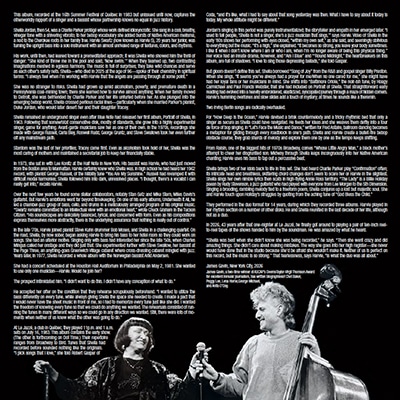
Harvie’s work, until then, had leaned toward a premeditated approach. It was Sheila who showed him the thrill of danger. “She kind of threw me in the pool and said, ‘Now, swim.'” When they teamed up, two contrasting imaginations meshed in ageless harmony. The music is full of surprises; they take wild chances and serve as each other’s safety nets. Sheila—who died in 2025 at the age of 96—spoke of their chemistry in spiritual terms: “I always feel when I’m working with Harvie that the angels are passing through at some point.”
She was no stranger to risks. Sheila had grown up amid alcoholism, poverty, and premature death in a Pennsylvania coal-mining town; there she learned how to survive almost anything. When her family moved to Detroit, she was befriended by Charlie Parker and her life unfurled before her. As she plunged into the emerging bebop world, Sheila crossed perilous racial lines—particularly when she married Parker’s pianist,Duke Jordan, who would later desert her and their daughter Tracey.
Sheila remained an underground singer even after Blue Note had released her first album, Portrait of Sheila, in 1963. Following that somewhat conservative disk, mostly of standards, she grew into a highly experimental singer, game for anything. Avant-garde musicians saw her as one of their own; in the 1970s, recordings she made with George Russell, Carla Bley, Roswell Rudd, George Gruntz, and Steve Swallow took her even further off any mainstream path.