
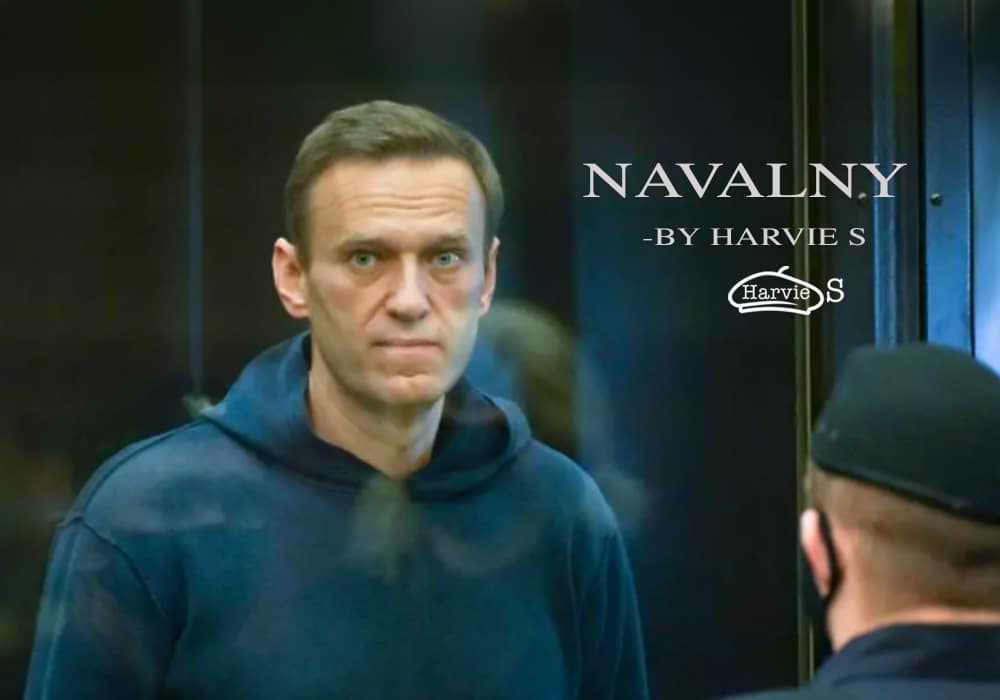
‘Navalny’ from Harvie S
Touched and Inspired by a Great Man
Alexei Navalny became a symbol of resistance to corruption and authoritarianism in Russia under Vladimir Putin. His investigations, especially into elite corruption, reached millions of ordinary Russians. And despite enormous personal risk, he chose to return to Russia after being poisoned—knowing full well what could happen.
He survived a poisoning attempt (linked to a nerve agent), was imprisoned upon return, and ultimately died in custody under harsh conditions. For many, that trajectory has made him a kind of martyr figure—someone who knowingly sacrificed his safety in the hope of a different future for his country. Such a brave man.
It also connects in a personal way to my family history. My grandparents were from Odessa—once part of the Russian Empire, that has long been a place where identities, cultures, and political realities have shifted. It’s hard to deny the courage it took to challenge power so directly in that system.
HARVIE S & YUKIMI MAEDA
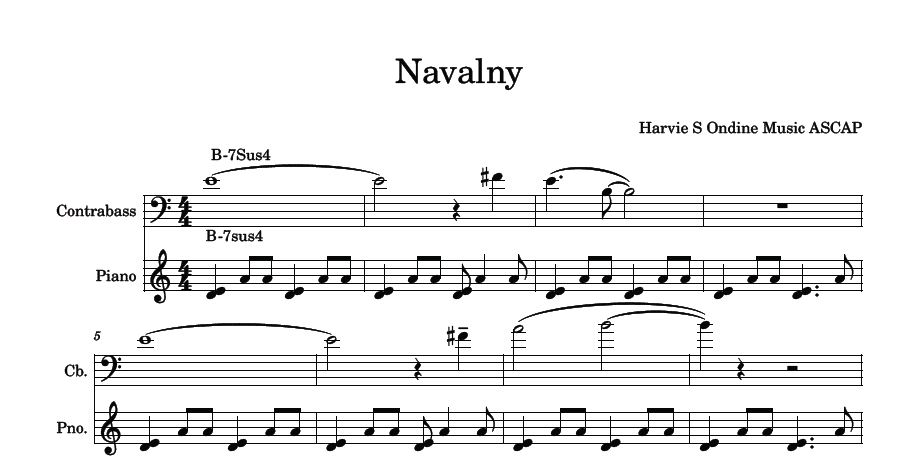
The Music in ‘Navalny’
I was deeply saddened about the horrific murder of Alexei Navalny. His death inspired me to write this composition.
A man sits alone in a prison cell.
Days pass, then weeks, then months. Time feels heavy and endless. Nothing changes. The walls are the same. The silence is the same.
This man is Alexei Navalny.
At first, he just sits there, waiting. There is nothing he can do. He is cut off from the world, from his work, from his people.
But inside his mind, something begins to move.
A thought.
An idea.
A sense of purpose.
For a moment, he feels inspired—like he wants to stand up, speak, act. Like he remembers why he fought in the first place.
But he can’t.
The walls are still there. The guards are still there. The cell closes in again. The moment fades.
So he returns to stillness.
Time passes again.
And then… it happens once more.
Another thought. Another spark. Another feeling that he must not give up. Even though he cannot act, something inside him is still alive.
Again, it rises.
Again, it is held back.
Again, he is forced into silence.
This becomes his reality:
inspiration… restraint… silence…
over and over.
But the important thing is this—
The inspiration never fully disappears.
Even in isolation, even in silence, even knowing the cost…
he does not let go of who he is or what he believes.
And in the end, though his life is taken, that inner voice—the part that refused to disappear—remains.
It lives on beyond the cell.
CLICK ON THE MUSIC BELOW TO DOWNLOAD A FREE COPY